My Guide to Planning Masonry Repairs for Older Kanata Homes With Brick, Stone, and Parging
Older homes often have more than one type of masonry that needs attention. A property may have brick exterior walls, natural stone around the entrance, a brick chimney, and parging covering the exposed foundation. Each material can age differently, and each can require a different repair approach.
When I assess an older home in Kanata, I do not automatically recommend repairing every masonry feature at the same time. I first look at the condition of the brick, mortar, stonework, chimney, and parging individually. Then I determine which areas need immediate attention, which repairs can be planned together, and which areas are still performing well enough to monitor.
For homeowners searching for masonry repair Kanata, brick repair Kanata, stone repair Kanata, parging repair Kanata, chimney repair Kanata, or residential masonry services Ottawa, having a clear repair plan can make maintaining an older property much easier.
Why I Look at the Entire Property Before Planning Repairs
A visible crack is often what first gets a homeowner's attention.
But one crack does not tell me the condition of the entire masonry system.
If I am called to look at deteriorated brick near an entrance, I may also inspect the surrounding mortar, nearby stonework, exposed foundation parging, and other accessible masonry areas.
The goal is not to find extra work.
The goal is to understand how the different masonry features are aging so repairs can be planned intelligently.
An older home can have one urgent masonry issue, several minor maintenance items, and large areas that remain perfectly sound.
I want to distinguish between them.
I Start by Separating the Different Masonry Materials
Brick, stone, mortar, and parging should not automatically be treated as one material.
They serve different purposes and deteriorate in different ways.
Brick can crack, chip, or spall.
Mortar joints can crumble, recede, or disappear.
Natural stone may remain sound while its surrounding mortar deteriorates.
Parging can crack, flake, crumble, or separate from the surface underneath.
Understanding which material has actually failed is the foundation of my repair plan.
My Approach to Older Brickwork
When I inspect brick on an older Kanata home, one of my priorities is determining how much original masonry can remain.
Age alone does not mean brick needs replacement.
I may find a wall where almost every brick remains serviceable while the mortar joints have deteriorated.
In that situation, repointing may be much more appropriate than replacing the brickwork.
On another property, the mortar may remain relatively sound while several individual bricks are badly damaged.
That requires a different repair.
How I Identify Brick That May Need Replacement
I look at the physical condition of individual bricks.
A brick may deserve closer attention if it is badly cracked, significantly spalled, broken, loose, or has lost a substantial amount of material.
Even then, I evaluate the surrounding masonry before recommending replacement.
If one brick has failed while twenty surrounding bricks remain sound, I prefer a targeted repair wherever practical.
I do not believe sound original masonry should be removed without a reason.
Why Spalling Brick Matters
Spalling occurs when the surface of a brick begins flaking, chipping, or breaking away.
The severity can range from minor surface deterioration to substantial material loss.
When I see spalling, I check nearby bricks for similar conditions.
One isolated brick may require a localized repair.
Several spalling bricks concentrated in one area may suggest that the section has experienced greater exposure and deserves a broader inspection.
Mortar Can Fail While Brick Remains Sound
This is one of the most important things I explain to homeowners.
Brick and mortar do not necessarily deteriorate together.
Mortar joints can become cracked, loose, recessed, or partially missing while the bricks remain serviceable.
When this happens, brick repointing Kanata may allow me to restore the deteriorated joints without unnecessarily replacing the original brick.
That can be particularly valuable on older homes where matching the appearance of existing brick may be difficult.
How I Approach Brick Repointing
Repointing involves removing deteriorated mortar where appropriate, preparing the joints, and installing replacement mortar.
Preparation matters.
I do not consider spreading a thin layer of new mortar over loose existing material to be the same as properly restoring a deteriorated joint.
My objective is to address failed mortar rather than simply improve its appearance temporarily.
Why I Preserve Original Brick Whenever Practical
Older brick has character.
Colour varies.
Texture varies.
Dimensions can differ from newer products.
Years of natural weathering also influence its appearance.
When an original brick remains sound, preserving it helps retain more of the home's established masonry.
Replacement is valuable when it is genuinely necessary, but I do not use it as the default solution.
Planning Repairs for Natural Stone
Stone requires its own assessment.
Many Kanata homes use stone around entrances, on facade sections, around fireplaces, or as decorative exterior features.
Natural stone itself can remain in excellent condition while the mortar surrounding it deteriorates.
In those cases, I focus on the joints rather than unnecessarily replacing good stone.
Signs Stonework May Need Attention
I look for crumbling mortar, missing joints, loose stones, cracked stones, previous repairs that are separating, and areas that appear to have shifted.
I also pay attention to whether the deterioration is localized or widespread.
A few deteriorated joints may require targeted repointing.
A loose but otherwise sound stone may potentially be reset.
A badly damaged stone may require replacement.
Visible movement across an entire section requires a different level of assessment.
Stone Repointing Can Preserve Existing Masonry
When the natural stone remains sound but mortar has deteriorated, repointing can be an effective restoration approach.
I remove failed mortar where appropriate, prepare the joints, and install replacement mortar.
Because natural stonework often contains irregular stones and joint widths, I work with the existing masonry rather than trying to make the repaired area look artificially uniform.
The character of the original stonework matters.
When I Reset Existing Stone
Sometimes a stone remains in good condition but has become loose because the surrounding mortar has failed.
If the condition allows, preserving and resetting that stone may make more sense than replacing it.
This helps retain the original material and can make the finished restoration look more natural.
I Take Significant Stone Movement Seriously
There is an important difference between a loose individual stone and a wall section that is bulging, leaning, or visibly shifting.
I do not simply fill the joints of significantly displaced masonry with fresh mortar and assume the issue has been corrected.
If the pattern suggests a condition beyond routine mortar deterioration, additional assessment may be appropriate before cosmetic restoration proceeds.
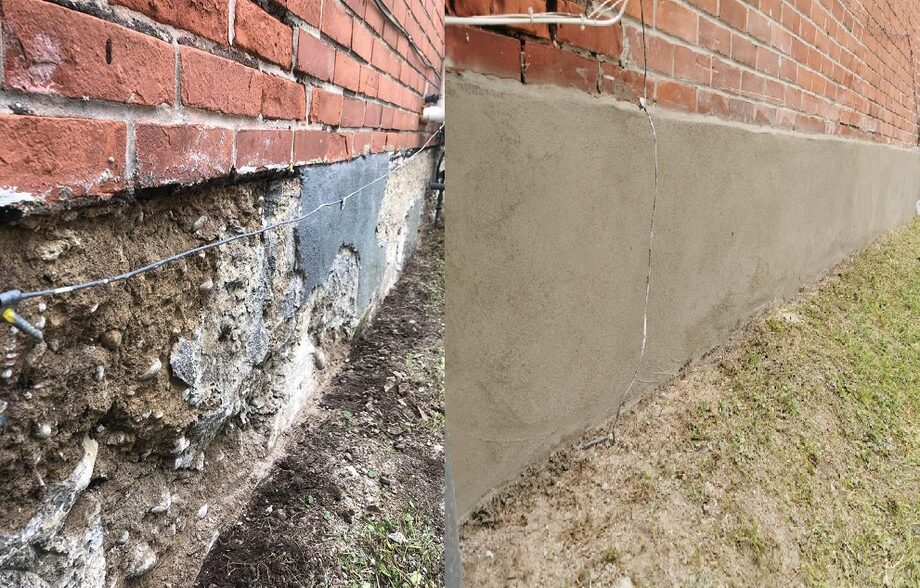
Planning Foundation Parging Repairs
Parging is another common area of concern on older Kanata homes.
It creates a finished and protective exterior surface over exposed foundation areas.
Over time, I may see cracks, flaking, crumbling, loose sections, or areas where the parging has separated from the surface underneath.
Just as with brick and stone, I begin by determining how much material remains sound.
Why I Do Not Simply Cover Crumbling Parging
If parging is already loose, putting another layer directly over it does not properly address the unstable material underneath.
Preparation is an important part of my repair process.
I identify deteriorated areas and remove loose material where appropriate.
The surface is then prepared before the repair is completed.
A fresh finish is only as useful as the surface supporting it.
Localized Parging Repair Versus Larger Restoration
One damaged section does not necessarily mean every visible part of the foundation needs new parging.
Sometimes deterioration is localized.
In other cases, cracking and separation are widespread.
I determine the repair scope from the actual condition.
This helps homeowners avoid both under-repairing a widespread problem and unnecessarily replacing material that remains serviceable.
Parging Is Not Structural Foundation Repair
I am careful about this distinction.
A damaged parging surface does not automatically mean a home's foundation has a structural problem.
At the same time, fresh parging cannot correct significant foundation movement if that is what is causing the visible damage.
If the condition suggests something beyond surface deterioration, further assessment may be needed.
I do not believe in hiding a potentially important condition behind a cosmetic coating.
Parging Is Not the Same as Waterproofing
Parging provides a finished and protective exterior coating, but I do not present it as a substitute for dedicated foundation waterproofing.
If a homeowner has water entering the basement, the source should be investigated.
Drainage, grading, foundation conditions, and other factors may need to be considered.
Applying new parging does not automatically solve every moisture issue.
I Include the Chimney in My Masonry Plan
Even when homeowners initially call about brick, stone, or foundation parging, I encourage them to keep an eye on their chimney.
A chimney is one of the home's most exposed masonry features.
Mortar can deteriorate.
Bricks can crack or spall.
Previous repairs can begin failing.
Because the chimney is exposed above the roofline, small masonry problems are worth identifying before they become widespread.
Chimney Repointing Versus Brick Replacement
If chimney bricks remain sound but mortar joints are deteriorating, repointing may be appropriate.
If individual bricks are significantly damaged, targeted replacement may also be necessary.
Many chimney restoration projects involve a combination of both.
I determine the appropriate approach from the masonry condition rather than automatically recommending complete rebuilding.
Chimney Repair Is Different From Chimney Cleaning
Homeowners searching for chimney repair Ottawa, Chimney Sweep Ottawa, or chimney cleaning near me may see these services listed together online.
They are different.
My chimney work focuses on masonry: brick, mortar, stone, repointing, and exterior restoration.
Chimney sweeping and flue cleaning are separate services.
Keeping this distinction clear helps homeowners find the correct professional for the work they actually need.
Why Kanata Weather Matters When Planning Masonry Work
Exterior masonry in Kanata experiences Ottawa's seasonal weather.
Rain, snow, ice, freezing temperatures, spring thawing, and summer heat all affect exterior materials.
Sound masonry is intended for outdoor exposure.
My concern increases when the material is already damaged.
An open mortar joint, spalling brick, loose stone, or cracked parging surface can be more vulnerable than surrounding sound masonry.
That is why preventive repair can be valuable.
Moisture and Freeze-Thaw Exposure
When moisture reaches vulnerable masonry and temperatures fall below freezing, already deteriorated areas can experience additional stress.
This does not mean every masonry problem is caused by freeze-thaw cycles.
There can be many contributing factors.
But in Kanata and the greater Ottawa area, moisture and changing winter temperatures are important considerations when I evaluate aging exterior masonry.
Why I Look at Drainage Too
If one section of masonry is deteriorating much faster than everything around it, I want to know why.
Roof runoff may repeatedly reach the wall.
A downspout may discharge too close to the foundation.
Landscaping may keep a lower section damp.
Snow may regularly accumulate against the masonry.
Repairing brick, stone, or parging addresses the damaged material, but reducing avoidable moisture exposure can help support the repair afterward.
How I Prioritize Multiple Masonry Repairs
When an older Kanata home has several masonry issues, I generally think about the work in terms of condition rather than appearance alone.
Loose or potentially unstable masonry deserves attention.
Significantly deteriorated areas may need to be prioritized.
Open joints and damaged bricks exposed to weather should be evaluated.
Minor cosmetic weathering may be monitored if the material remains sound.
This allows homeowners to develop a repair plan based on actual need.
Safety Comes Before Appearance
A faded mortar joint may be visually unattractive.
A loose masonry unit can be a more important concern.
That difference matters when prioritizing repairs.
If I identify a condition that appears unstable or potentially related to significant movement, I recommend dealing with that concern before focusing on purely cosmetic improvements elsewhere.
I Consider Whether Repairs Can Be Combined
Sometimes it makes sense to address several nearby masonry issues together.
For example, an entrance may have deteriorated brick mortar, several loose stones, and damaged parging underneath.
Because these areas are physically close, planning the repairs together may create a more coordinated restoration.
On another home, chimney work and foundation parging may be completely separate projects and can be planned independently.
The property determines the strategy.
I Do Not Recommend Repairing Everything Just Because It Is Old
Older masonry naturally looks older.
That is not a defect by itself.
A stone does not need replacement because its colour has changed.
A brick does not need removal because it has weathered.
Mortar does not necessarily need complete replacement because it is no longer visually identical to new material.
I focus on physical condition and performance.
That keeps the project grounded in actual maintenance needs.
Previous Repairs Are Part of My Assessment
Older homes often have multiple generations of masonry work.
One section may have been repointed years ago.
Several bricks may already have been replaced.
Parging may contain previous patches.
Stone mortar may vary between different areas.
I inspect these repairs rather than automatically removing them.
If they remain sound, they may be left alone.
If they are failing, I consider what should be corrected and whether there is a pattern behind the deterioration.
Repeated Cracking Deserves More Attention
If the same crack keeps returning after repeated repairs, I want to understand why.
Applying another layer of mortar or parging may not be the best solution if movement or another underlying condition is responsible.
This is particularly important around openings, foundations, and masonry sections that appear displaced.
Repair planning should address what I can reasonably identify rather than repeatedly hiding the same symptom.
Brick Around Windows and Doors
Windows and doors are areas I inspect carefully on older brick homes.
Cracking can sometimes develop around openings.
Some cracks may be related to normal mortar deterioration.
Others may have patterns that deserve additional assessment.
I look at the surrounding bricks, joints, and overall alignment before deciding whether straightforward repointing is appropriate.
Stone Around Entrances
Natural stone entrances are another area where several materials can meet.
Stone may sit above parging.
Brick may connect to the stone.
Concrete steps or walkways may be nearby.
When deterioration occurs, I assess each material individually.
This prevents me from applying one repair method to several different conditions.
Lower Walls and Foundations
Masonry close to ground level often receives substantial moisture exposure.
Rain splashes onto it.
Snow accumulates beside it.
Landscaping can keep it damp.
When brick, stone, or parging deterioration is concentrated near the ground, I consider these surrounding conditions as part of the repair plan.
Why Small Masonry Repairs Can Be Worth Doing
Not every project needs to be large.
A few damaged bricks can be replaced.
A localized group of mortar joints can be repointed.
One loose stone may be repairable.
A deteriorated section of parging may be restored.
For homeowners searching for small masonry services Ottawa, these focused repairs can be an important part of maintaining an older property.
Addressing deterioration while it remains localized can help keep the restoration manageable.
What Influences Masonry Repair Cost?
The cost of masonry work depends heavily on the scope and condition.
Accessibility matters.
Height matters.
The amount of preparation matters.
Material matching can matter.
The number of bricks or stones requiring replacement matters.
The amount of mortar requiring repointing matters.
Parging preparation can vary depending on how much existing material is loose.
Previous repairs may also affect the work.
This is why I do not believe one generic price accurately represents masonry repair on every older Kanata home.
Planning Repairs in Stages
Not every homeowner wants or needs to complete every masonry repair at once.
If several areas need attention, I can help identify logical priorities.
The most deteriorated or concerning masonry can be addressed first.
Other maintenance can be planned for a later stage.
Sound masonry can simply continue to be monitored.
A phased approach can make a larger property restoration easier to manage.
Spring Is a Good Time to Review Masonry Condition
After winter, I recommend walking around the property and checking accessible masonry.
Look at brick faces.
Inspect mortar joints.
Look for loose stone.
Check foundation parging.
View the chimney safely from the ground.
Look for material fragments.
Compare previous repairs with their earlier condition.
This can help reveal changes that occurred through winter.
Fall Is Another Useful Planning Period
Before winter, I recommend another visual check.
If joints are already open or masonry is loose, those areas are about to face another season of snow, ice, moisture, and freezing temperatures.
An assessment does not necessarily mean every repair must happen immediately.
It gives homeowners the information needed to plan appropriately.
Masonry Consulting for Older Kanata Properties
For a home with multiple masonry materials, consultation can be particularly useful.
My masonry consulting can help with project planning and feasibility, masonry design considerations, and material selection guidance.
If a property has brick, natural stone, chimney masonry, and foundation parging all requiring different levels of attention, creating an organized plan can prevent homeowners from treating each issue as an unrelated emergency.
My Residential Masonry Services
My work can include residential brick construction, brick repair, brick repointing, brick fireplaces, chimney repair and restoration, flagstone, patios, stone repointing, natural stone facades, stone veneers, stone fireplaces, stone walls, foundation parging, exterior wall finishing, parging repairs and maintenance, and masonry consulting.
The important part is matching the service to the actual condition of the property.
Serving Kanata and the Greater Ottawa Area
Although this guide focuses on older homes in Kanata, I provide masonry services throughout Ottawa and surrounding communities, including Nepean, Barrhaven, Orleans, Gloucester, Greely, Metcalfe, Downtown Ottawa, and nearby areas.
Every home is different.
Some need primarily brick repointing.
Others need stone restoration.
Some require parging repairs.
Many older properties need a combination of smaller masonry projects rather than one complete replacement.
When I Recommend Scheduling a Masonry Assessment
I recommend an assessment when bricks are spalling or badly cracked, mortar joints are crumbling or missing, stones are loose, parging is separating, chimney masonry is deteriorating, previous repairs are failing, or cracks repeatedly return.
I also recommend taking visible movement seriously.
If masonry is bulging, leaning, shifting, or significantly displaced, further assessment may be appropriate rather than simply covering the condition with fresh mortar or parging.
My Guide to Planning Masonry Repairs for Older Kanata Homes With Brick, Stone, and Parging
When I plan masonry repairs for an older Kanata home, I do not begin with the assumption that everything needs replacement.
I begin with an inspection.
I determine which bricks remain sound.
I examine the mortar joints.
I inspect natural stone.
I look for loose masonry.
I assess foundation parging.
I review the chimney.
I consider previous repairs and moisture exposure.
Then I separate immediate concerns from routine maintenance and cosmetic aging.
This allows me to create a restoration approach focused on preserving sound existing materials while repairing the areas that have genuinely deteriorated.
For homeowners searching for masonry repair Kanata, brick repair Kanata, brick repointing Kanata, stone repair Kanata, parging repair Kanata, chimney repair Kanata, masonry repair Ottawa, masonry Ottawa, residential masonry services Ottawa, or small masonry services Ottawa, thoughtful planning can make maintaining an older property much more manageable.
At Lesway Masonry, I take pride in helping homeowners throughout Kanata and the greater Ottawa area understand the condition of their brick, stone, mortar, chimney masonry, and foundation parging before deciding what to repair.
My goal is to preserve sound masonry wherever practical, restore deteriorated areas properly, and help homeowners create a sensible repair plan based on what their property actually needs—not simply how old it is.
