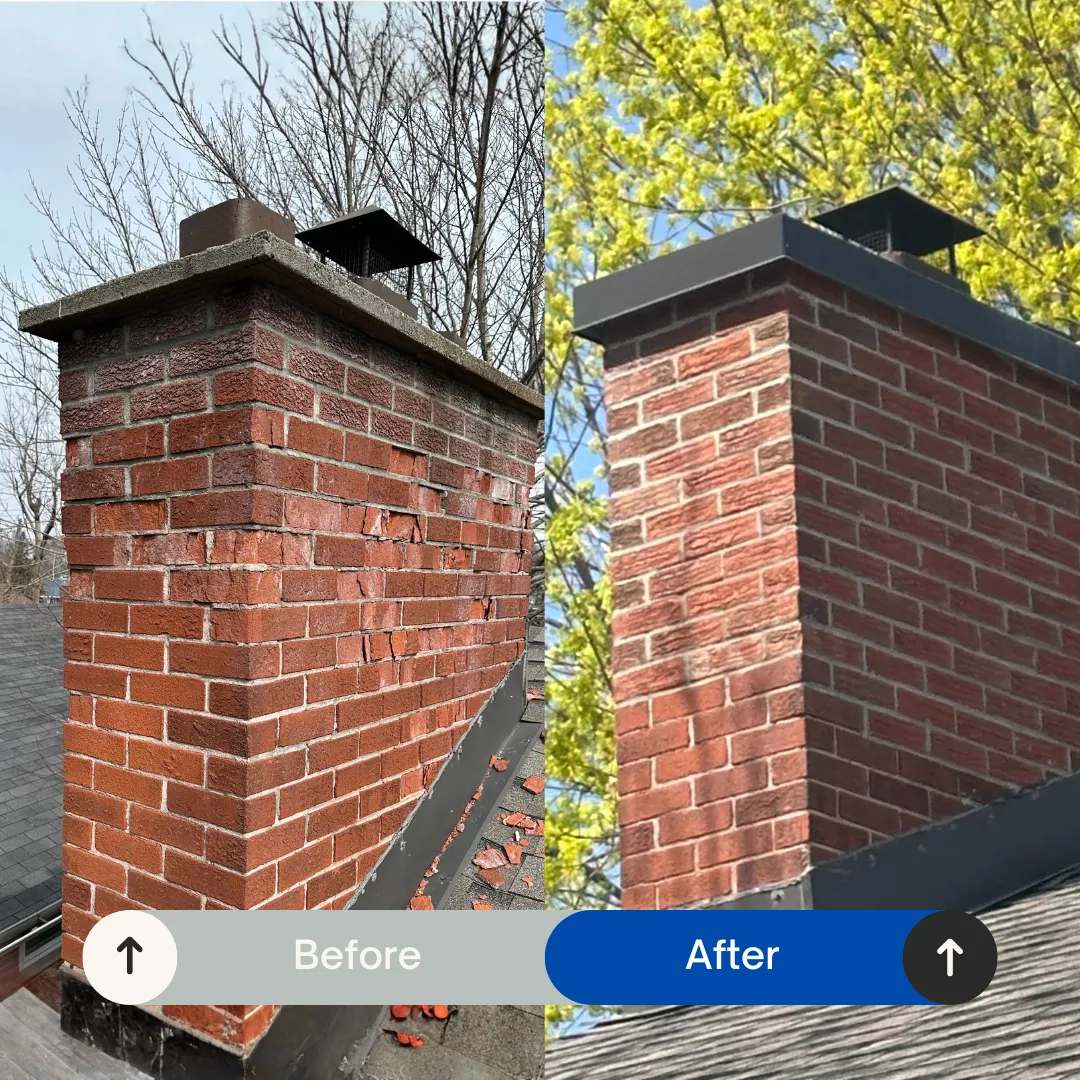
Why I Recommend Inspecting Chimney Brickwork on Older Metcalfe Homes Before Small Repairs Become Larger
When I look at the exterior masonry on an older home in Metcalfe, the chimney is one of the areas I believe deserves regular attention. A chimney can appear solid from the ground while mortar joints, individual bricks, or previous repairs are gradually beginning to deteriorate.
Because the chimney extends above the roofline, it is also one of the home's most exposed masonry features. Rain, snow, ice, wind, freezing temperatures, and repeated seasonal changes can all affect masonry that is already showing signs of age.
This is why I prefer finding small chimney masonry problems early.
A few deteriorated mortar joints may be suitable for targeted repointing. One or two damaged bricks may be individually replaced while surrounding masonry remains sound. But when these conditions are left for years, deterioration can involve a larger section of the chimney and make restoration more extensive.
For homeowners searching for chimney repair Metcalfe, chimney repair Ottawa, brick repair Ottawa, masonry repair Ottawa, or residential masonry services Ottawa, a masonry inspection can help determine what actually needs attention before assuming a major chimney restoration is necessary.
Why Chimneys Need Different Attention From Exterior Walls
A brick wall on a home and a brick chimney may use similar masonry materials, but their exposure can be very different.
Most exterior walls receive at least some protection from roof overhangs, architectural features, or their orientation.
A chimney rises above the roof.
It can receive weather from several directions.
Rain can strike it directly.
Snow and ice can collect around it.
Winter winds expose it to changing temperatures.
Sunlight can warm one side while another remains colder.
These conditions do not automatically cause chimney failure, but they are important when the mortar or brickwork is already deteriorating.
What I Look for During a Chimney Masonry Inspection
I do not look only for dramatic damage.
Some of the most useful warning signs are relatively small.
I examine visible mortar joints for cracking, crumbling, recession, and missing sections.
I look for individual bricks with chipped or deteriorating faces.
I check for cracks through bricks.
I look at corners and edges.
I examine previous repairs where possible.
Most importantly, I look at the chimney as a complete masonry feature rather than focusing on one obvious damaged spot.
Deteriorating Mortar Is Often an Early Warning Sign
Mortar joints are an important part of brick masonry.
As they age, some joints may gradually become recessed or begin breaking down.
A small amount of weathering does not automatically mean the chimney needs major work.
However, when mortar becomes deeply recessed, loose, cracked, or missing, I want to assess it.
If the surrounding bricks remain serviceable, repointing may allow me to restore those deteriorated joints without unnecessarily replacing the brickwork.
What Chimney Repointing Involves
Repointing is a targeted masonry restoration process.
I identify deteriorated mortar joints and remove failed mortar where appropriate.
The joints are prepared before replacement mortar is installed and finished.
This is different from simply spreading a fresh layer over the visible surface.
If loose material remains underneath, a cosmetic covering does not properly address the deteriorated joint.
Good preparation is one of the most important parts of the repair.
Why I Do Not Automatically Replace Old Chimney Bricks
Age alone is not a reason for me to replace a brick.
Some older bricks remain perfectly serviceable even when the mortar around them requires attention.
Removing those bricks would unnecessarily disturb original masonry and increase the repair scope.
My approach is to evaluate the brick and mortar separately.
If the brick remains sound, I want to preserve it.
If the mortar has deteriorated, I can address the joint.
If the brick itself has failed, I can determine whether individual replacement is appropriate.
When Individual Brick Replacement Makes Sense
Sometimes the mortar is not the only problem.
A brick may be badly cracked.
Its face may have broken away.
A corner may be missing.
The brick may have deteriorated significantly enough that keeping it is no longer the best option.
In those situations, I can carefully remove the affected brick and install an appropriate replacement while preserving surrounding units whenever practical.
This is one reason early inspection can be valuable.
A chimney containing only a few damaged bricks may still be suitable for targeted restoration.
Spalling Brick on Metcalfe Chimneys
Spalling is one type of deterioration I pay particular attention to.
A spalling brick begins losing its outer surface.
At first, the face may simply look rough.
Then flakes or chips can break away.
With more advanced deterioration, a substantial portion of the brick face can disappear.
When I find spalling, I evaluate the severity rather than automatically assuming every affected brick needs replacement.
Minor weathering and significant material loss are not the same condition.
Why Moisture Matters
Moisture is one of the environmental factors I consider when inspecting chimney masonry.
If mortar joints are open or brick surfaces have deteriorated, moisture can reach vulnerable areas more easily.
Then winter arrives.
When moisture in vulnerable masonry is exposed to freezing temperatures, repeated freezing and thawing can place additional stress on material that is already deteriorating.
I do not attribute every chimney problem to freeze-thaw cycles, but in the Ottawa region, they are an important consideration.
Metcalfe Winters Make Preventive Inspection Worthwhile
Metcalfe homes experience long periods of cold weather, snow, ice, and seasonal temperature changes.
For sound masonry, these conditions are part of normal exterior exposure.
My concern increases when a chimney enters winter with existing deterioration.
Missing mortar remains missing.
Cracked joints remain open.
Spalling brick remains vulnerable.
That is why I recommend identifying these areas before they become more extensive.
Spring Is an Excellent Time to Look at Chimney Masonry
After winter, homeowners can visually check the chimney from a safe location.
I never recommend climbing onto a roof simply to perform a casual inspection.
Instead, look for visible changes.
Does one section appear more weathered?
Can you see missing mortar?
Do any brick faces look damaged?
Are there visible cracks?
Has a previous repair changed?
If something looks different from the previous season, a professional assessment can help determine whether masonry work is needed.
Fall Is Another Good Inspection Period
Fall gives homeowners an opportunity to consider chimney masonry before another winter.
If mortar joints are already badly deteriorated or individual bricks are visibly damaged, I would rather evaluate those areas before months of snow and freezing weather arrive.
Not every issue needs immediate major work.
The point of inspection is to understand the condition and determine an appropriate repair plan.
Small Chimney Repairs Can Be Valuable
Homeowners sometimes assume a masonry contractor is only necessary when a chimney is severely deteriorated.
That is not how I look at preventive masonry maintenance.
A handful of deteriorated joints can be worth addressing.
One damaged brick can be worth replacing.
A small failed section of previous repointing can be evaluated.
For homeowners looking for small masonry services Ottawa, localized chimney work can help preserve a much larger masonry feature.
Why Waiting Can Increase the Repair Scope
Masonry deterioration does not follow an exact schedule.
I cannot look at a cracked mortar joint and predict precisely what it will look like three winters from now.
What I can say is that existing deterioration generally does not improve on its own.
A missing joint does not replace itself.
A spalling brick does not regain its lost surface.
A loose section does not become secure because another season passes.
Addressing localized deterioration gives me the opportunity to keep the repair focused.
I Inspect More Than the Most Obvious Problem
Suppose a homeowner calls me because one chimney brick looks damaged.
I do not inspect only that brick.
I look at neighbouring units.
I examine the mortar.
I check nearby corners.
I consider whether several bricks show the same pattern.
I look at previous repairs.
This broader view helps me determine whether the damaged brick is an isolated problem or part of a larger deteriorating area.
Patterns of Damage Can Tell Me More
The location of deterioration matters.
One damaged brick may represent a localized issue.
Several deteriorated bricks grouped together may indicate that a particular section has experienced heavier exposure.
Mortar deterioration concentrated on one side of the chimney can also be informative.
I use these patterns to guide my assessment instead of treating every visible defect independently.
Previous Chimney Repairs Deserve Attention
Many older Metcalfe homes have chimneys that have already received some masonry work.
I may see newer mortar beside original joints.
Several bricks may have been replaced.
A section may contain an older patch.
Previous repairs are not automatically a problem.
If they remain sound, I take that into account.
But if the replacement mortar is cracking, separating, or deteriorating, I want to understand the condition before another repair is applied over it.
Why I Avoid Cosmetic Patching
A cosmetic patch can make a chimney look better from a distance without necessarily correcting the underlying deterioration.
If mortar is loose, I want failed material properly addressed.
If a brick is badly deteriorated, covering its surface may not be an appropriate substitute for replacement.
If masonry is moving, filling the visible crack does not necessarily correct the cause.
My goal is restoration, not simply hiding warning signs.
Movement Requires a Different Kind of Attention
Some crack patterns deserve more caution than routine mortar deterioration.
If chimney masonry appears significantly displaced, unstable, leaning, or separated, I do not assume that repointing alone will solve the condition.
Additional assessment may be appropriate.
I believe this distinction is important because mortar should not be used to conceal evidence of a problem that requires a different solution.
Chimney Leaks Are Not Always Masonry Problems
If a homeowner notices water around a chimney inside the house, deteriorated brick or mortar may be one possible contributor.
But it is not the only possible source.
Roofing, flashing, chimney components, and other building conditions can also be involved.
I do not assume masonry repair will solve every leak simply because the moisture appears near the chimney.
The source should be identified before the repair is chosen.
Chimney Masonry Repair and Chimney Sweeping Are Different
Homeowners searching online for chimney repair near Metcalfe, Ottawa, Chimney Sweep Ottawa, or chimney cleaning near me may encounter several different types of chimney businesses.
My work focuses on masonry.
That includes deteriorated brick, mortar joints, repointing, brick replacement, and exterior chimney masonry restoration.
Chimney sweeping and flue cleaning are separate services.
A chimney may need both types of maintenance, but one should not be confused with the other.
Brick Matching Matters During Chimney Restoration
If I need to replace individual bricks, I consider how the replacement will relate to the existing chimney.
Older brick can have distinctive colour, texture, dimensions, and weathering.
An exact match is not always available.
However, careful material selection can help new masonry integrate more naturally with the original work.
This is another reason I preserve sound existing brick whenever practical.
Mortar Appearance Matters Too
Mortar represents a significant part of the visible chimney.
Fresh joints that look dramatically different from the surrounding masonry can make repairs stand out.
I consider the existing mortar's appearance and joint profile when completing restoration.
The goal is not to make an older chimney look artificially new.
I want the repair to work appropriately with the established masonry.
Why I Recommend Targeted Restoration
My approach is based on actual condition.
If only the mortar has deteriorated, I consider repointing.
If several individual bricks are damaged, I consider targeted brick replacement.
If both conditions exist, the project may combine the two.
If a larger section is extensively deteriorated, more substantial restoration may be appropriate.
I do not automatically recommend the largest repair.
What Determines Chimney Repair Cost?
Homeowners frequently search for chimney repair cost, but chimney projects can vary considerably.
The amount of deteriorated mortar matters.
The number of bricks requiring replacement matters.
Height and accessibility matter.
The condition of previous repairs can influence preparation.
The extent of deterioration also matters.
Repointing a limited section is very different from restoring a chimney with widespread brick and mortar damage.
That is why an inspection is the best starting point for determining the scope.
Chimney Inspection Can Reveal Related Brickwork Problems
While evaluating a chimney, I encourage homeowners to consider the rest of the exterior brickwork too.
Mortar joints on walls can deteriorate.
Brick around windows and doors can crack.
Individual units can spall.
If these problems are found early, targeted brick repair Ottawa or repointing may preserve the surrounding masonry.
Older Metcalfe Brickwork Often Benefits From Preservation
Older homes have character partly because their materials have history.
Original brick may have colours and textures that are difficult to reproduce exactly.
When it remains sound, I prefer keeping it.
Preservation does not mean ignoring deterioration.
It means distinguishing between masonry that is still performing and masonry that genuinely needs repair.
Stonework Can Be Evaluated at the Same Time
Some Metcalfe homes combine brick with natural stone.
If I am already looking at exterior masonry, I may notice deteriorated mortar joints in stone features as well.
Sound natural stone does not necessarily need replacement because the surrounding mortar has aged.
Stone repointing can often restore deteriorated joints while preserving the existing material.
Foundation Parging Should Also Be Monitored
Foundation parging is another exterior masonry surface that can show signs of age.
I recommend watching for cracking, flaking, crumbling, and loose sections.
When parging repair Ottawa is required, I inspect the existing finish and the surface underneath before determining the repair.
Parging provides a finished and protective exterior coating, but it should not be treated as a substitute for structural foundation repair, drainage correction, or dedicated waterproofing when those separate conditions exist.
A Whole-Property Masonry Inspection Can Help Prioritize Work
An older property may have several masonry concerns at once.
The chimney needs repointing.
Several exterior bricks are deteriorating.
Stone mortar is recessed.
Foundation parging is beginning to crack.
That does not necessarily mean everything must be completed at once.
An inspection can help identify which areas require attention and which can continue to be monitored.
Masonry Consulting for Older Homes
For properties with several aging masonry features, project planning can be valuable.
I can assess brick, stone, mortar, chimney masonry, and parging and help homeowners understand the restoration priorities.
This is particularly useful when someone has recently purchased an older property and does not know which repairs were previously completed.
Residential Masonry Services in Metcalfe
My masonry services can include brick repair and replacement, brick repointing, residential brick construction, chimney repair and restoration, natural stone repair, stone repointing, stone walls, natural stone facades, stone veneers, foundation parging, parging repairs and maintenance, exterior wall finishing, and masonry consulting.
The service I recommend depends on what I find—not simply the age of the home.
When I Recommend Calling for a Chimney Masonry Inspection
I recommend having the chimney assessed when mortar joints are visibly cracked, loose, deeply recessed, or missing; brick faces are flaking or breaking away; individual bricks are badly cracked; previous repairs are failing; or the chimney looks noticeably different from previous seasons.
I also recommend taking visible movement seriously.
If the masonry appears unstable, significantly displaced, or leaning, further assessment may be necessary rather than simply repointing the joints.
Why Early Inspection Can Keep Repairs Focused
This is ultimately why I encourage Metcalfe homeowners to pay attention to their chimney before deterioration becomes extensive.
If the majority of the chimney remains sound, I may be able to preserve most of it.
A few deteriorated joints can be repointed.
Several damaged bricks can potentially be replaced individually.
Sound masonry can remain undisturbed.
The longer significant deterioration continues, the greater the possibility that a larger restoration scope will eventually be required.
Why I Recommend Inspecting Chimney Brickwork on Older Metcalfe Homes Before Small Repairs Become Larger
I believe good masonry restoration begins with understanding what actually needs repair.
When I inspect an older chimney, I separate the condition of the brick from the condition of the mortar.
I look for spalling.
I inspect deteriorated joints.
I examine previous repairs.
I consider weather exposure.
I look for patterns of deterioration and signs of movement.
Then I determine whether repointing, individual brick replacement, a combination of repairs, or a more extensive assessment is appropriate.
For homeowners searching for chimney repair Metcalfe, chimney repair Ottawa, brick chimney repair Ottawa, chimney repointing Ottawa, brick repair Ottawa, masonry repair Ottawa, masonry Ottawa, residential masonry services Ottawa, or small masonry services Ottawa, an early inspection can provide a much clearer picture of what the chimney actually needs.
At Lesway Masonry, I take pride in helping homeowners throughout Metcalfe and the greater Ottawa area maintain and restore aging chimney masonry. My approach focuses on careful inspection, professional repointing, targeted brick replacement, and preserving sound existing masonry wherever practical.
A chimney does not need to reach the point of major deterioration before it deserves attention. Finding the smaller problems early gives me the best opportunity to keep the repair targeted, preserve more of the original masonry, and help homeowners plan restoration before a manageable issue develops into a much larger project.
